Why the lowest carbon building is the one already standing

Article
Article
plus iconArrow icon
Why the lowest carbon building is the one already standing
Project Stories

The climate case for working with what already exists, illustrated through three of our recent adaptive reuse projects.

The most sustainable building is almost always the one that has already been built. Embodied carbon already committed in existing fabric, foundations, and structure represents a carbon investment that has already been paid. To demolish and rebuild is to pay that cost again, and to add the carbon emissions of demolition and disposal on top.

Yet contemporary practice routinely demolishes serviceable buildings to make way for new construction. The reasons are usually framed in terms of performance: existing buildings cannot meet contemporary thermal and energy standards. But when the full lifecycle carbon footprint is calculated, including embodied carbon and demolition emissions, retention and retrofit almost always outperforms demolition and rebuild over realistic time horizons.
  • Retention of existing structure and facade typically saves 40 to 60 percent of the embodied carbon of equivalent new construction
  • The operational carbon penalty of retained buildings can be addressed through deep retrofit at a fraction of the embodied carbon cost
  • The break-even point at which a new building outperforms a retrofitted existing building, on whole-life carbon, is typically 60 to 80 years in the future, longer than most contemporary buildings are designed to last
Architectural warmth

The argument applies even at the smaller scale

The carbon case for retention does not only apply to large heritage buildings. It applies equally to ordinary post-war commercial buildings, mid-century housing stock, and Wilhelminian-era buildings of no formal heritage value. Each of these represents committed embodied carbon that should be retained where the brief allows.

  • Speicherstadt Hotel, Hamburg: 92 percent of existing structure retained, embodied carbon saving of approximately 1,400 tonnes CO2e against equivalent new build
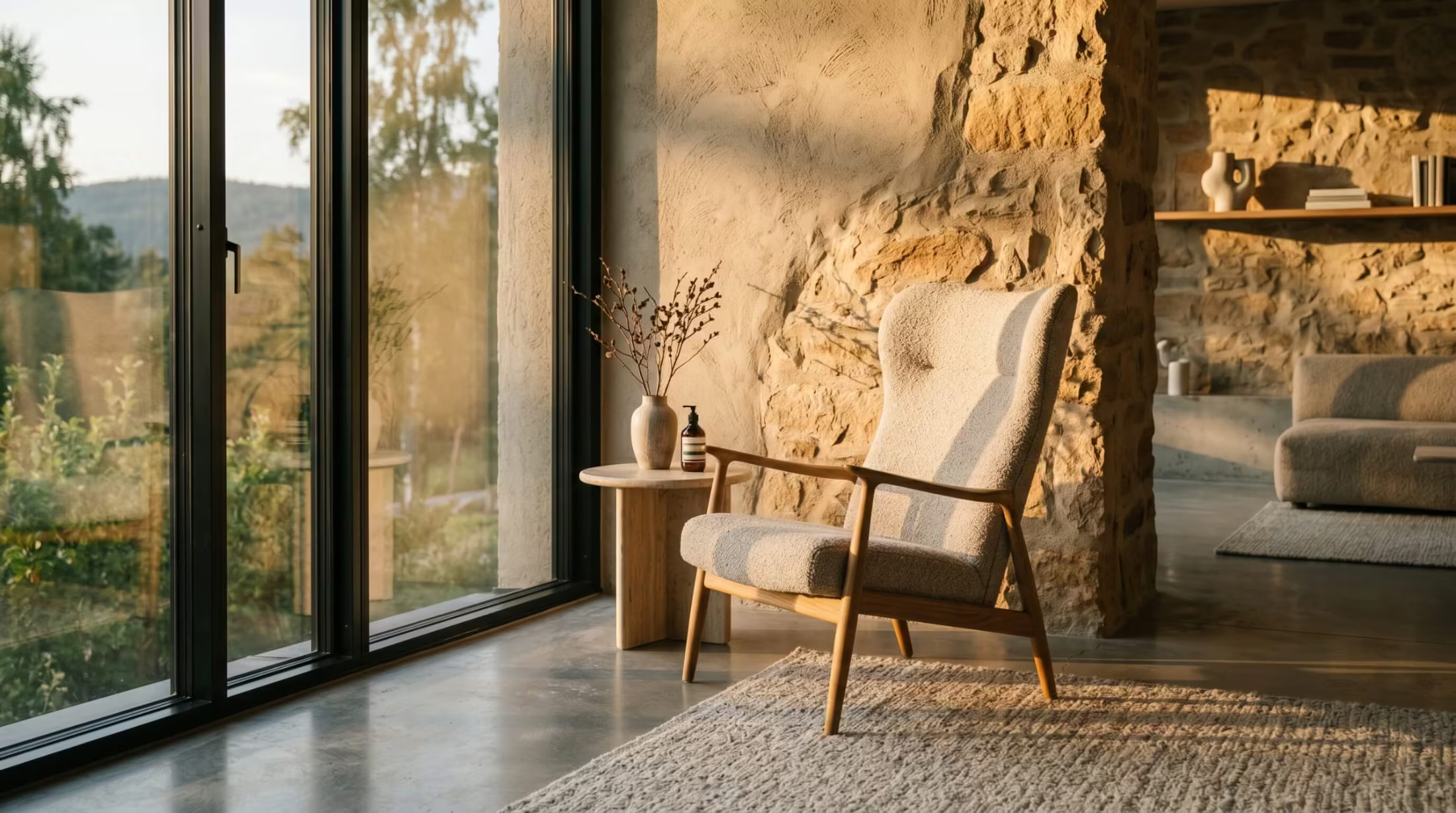
  • Schorfheide Farmhouse, Brandenburg: full retention of original fabric with internal retrofit to EnerPHit standard
  • Friedrichshain Werkhof, Berlin: retention of brick shell and steel structure within new residential conversion
"The carbon argument for retention has become impossible to ignore. Every brief we receive begins with the question of whether something existing can be retained and adapted, and only moves to new build if the answer is genuinely no."

Additional articles

All journal posts

Designing interiors that age well: A material philosophy
Design Insights

Designing interiors that age well: A material philosophy

Read
Read
plus iconArrow icon
Designing for the second family: Residential architecture for change
Design Insights

Designing for the second family: Residential architecture for change

Read
Read
plus iconArrow icon
Speicherstadt Hotel: a hotel built into a Hamburg warehouse
Project Stories

Speicherstadt Hotel: a hotel built into a Hamburg warehouse

Read
Read
plus iconArrow icon